Friday, 15 November 2013

Mr B's Reading Year, One: 'the unknown merchandise at the end of their wait'

When Anna decides to walk home from work a different way one day, she stumbles upon a boarded-up kiosk with a brief line forming. This is an unsurprising sight in Leningrad after 'the Change', with the novel's twentieth-century Soviet setting based, in the author's own words, on 'the repression of Stalin's 1930s, the hopefulness of Kruschchev's Thaw (late 1950s - early 1960s) and the stagnation of Brezhnev's 1970s.' However, Anna is drawn to this particular kiosk, and alongside her husband Sergei and son Alexander, becomes a regular visitor to the line. It is only after visiting for some time that the family discover that the kiosk will be selling concert tickets for the composer Selinsky's triumphal return to his home country to conduct his last symphony a single time, a plotline based on Stravinsky's historic concert of 1962. Anna determines to purchase one for her fading mother, who still recalls her brighter days as a ballerina, but as the family form a rough shift system to hold their place in the line, personal desires begin to take over. As Anna thinks at the very beginning of the novel, when she is set free from her teaching job into 'the glittering white stretch of the afternoon', she will go to the kiosk, where she is filled 'with a sure presentiment of a change… something, she thought, to make her and her family happier, or lend some simple beauty to her everyday life.' The possibilities offered by the kiosk sit in contrast to the Soviet winter, where 'time had all run together for quite a while… like a vat of frozen concrete.'

The use of the American word 'line' rather than the British 'queue' both makes sense, given that Olga Grushin lives in Washington DC, and is more resonant within the novel as a whole, as characters speak of coming 'to the end of the line.' Predictably, waiting becomes an emotional event in itself for Anna, Sergei and Alexander, as Anna battles with her desire to have just one thing that is her own, Sergei embarks on an illicit affair with a fellow queue-goer, and Alexander paints the town red with new acquaintances. The line reflects the realities of their lives in this version of Soviet Russia, where little changes, but hope remains constant that something will. Putting it this way makes the novel sound banal, but the skill of Grushin's writing makes the conceit work. She is particularly good on weather and its emotional resonance, whether that's the sky waving 'back and forward in a skeletal dance of black branches' or the 'skinny parings of sunlight' that squeeze through the gaps in Anna's curtains. She is even better on dreams and dream-like imaginings, a ferociously difficult thing for an author to write well. Whether it's Alexander fantasising about the train he will take to 'a remote, desolate, beautiful shore, and strange birds dipping and rising overhead, and whispers of tall silver trees, and horses running, and the sea' or Anna's mother's memories of 'mermaids sipping frothy drinks from dainty little cups in terraced cafes', Grushin continually finds the balance between the cliched figures (the horses, the sea, the cafes) and the personal detail that characterises all our fantasies.

So there is much to admire in The Concert Ticket, but for all this, the novel remains curiously static. Of course, given its subject-matter, this is deliberate, but I found myself wondering if it might have worked better as a novella rather than something that's over three hundred pages long. It reminded me strongly of Russian absurdist fiction, particularly Gogol's short stories, although it is obviously rooted in a realist tradition as well, and also of folk storytelling, given its quasi-mythical setting and the orderly repetition of certain events. Given this, I felt a shorter form might have worked here as well, especially as the only character I felt I could truly care about was Anna. It's a beautiful read that captures the experience of longing for something undefined that one can't have better than almost anything else I've read, but in the end, the wait is too long and the pay-off too small.


This was the first book from my Mr B's Reading Year, and although I had mixed feelings about it, I'd still like to thank Mr B's for their selection - I would never have chosen this novel for myself, and I'm very glad to have read it.

Friday, 8 November 2013

Farthest North and Farthest South, #5: 'the cleanest and most isolated way of having a bad time'

It would be easy to consider the highlight of this book, as of the Cambridge Scott Polar Museum itself, where I bought it from, to be the intensely memorable excerpts from Captain Scott's last letters which Apsley Cherry-Garrard quotes near the end of his long text. From Scott's 'Message to the Public', a quotation from which appears on the wall next to the entrance of the Polar Museum, Cherry-Garrard quotes: 'Had we lived, I should have had a tale to tell of the hardihood, endurance and courage of my companions which would have stirred the heart of every Englishman. These rough notes and our dead bodies must tell the tale, but surely, surely a great rich country like ours will see that those who are dependent on us are properly provided for.' In more scattered language, but conveying almost precisely the same message, Scott pens his last diary entry: 'Every day we have been ready to start for our depot 11 miles away, but outside the door of the tent it remains a scene of whirling drift. I do not think we can hope for any better things now. We shall stick it out to the end, but we are getting weaker, of course, and the end cannot be far. It seems a pity, but I do not think I can write more. For God's sake, look after our people.' However, powerful as these excerpts are, it seems to me that they only acquire their true power when the reader is able to look at them outside pre-conceptions of Edwardian bombast and heroism, outside 'the myth of Scott', most recently dissected by Max Jones in The Last Great Quest (2004), and to recognise the truth of what Scott is saying about the qualities these men possessed. It is easy to read a quotation on a wall and believe that it is false, but after the long attrition of the details Cherry-Garrard provides about the true horror of the polar journey and his own 'worst journey in the world', 'the winter journey' to collect the eggs of Emperor penguins, it is harder not to be moved by Scott's words, and to feel much more able to relate to his experience that to that of a faceless imperial hero.

The key quality, of course, that Cherry-Garrard possesses, apart from his first-hand knowledge of the polar expedition, is the ability to write, but the success of this account is not his alone. It relies heavily on excerpts from diaries kept by the other men, most notably, Henry Bowers, who accompanied Scott to the Pole. I find it astonishing that in such conditions Bowers, Scott and Cherry-Garrard himself, who utilises his own field notes, were able to write such lucid and engaging prose, especially as none of them were 'literary' men, and wonder how far this was typical of the nineteenth-century elite. The pressures of travel mean that few of the diaries indulge in the more formal style adopted by Scott in his 'Message to the Public', and instead, get straight to the point, as when Cherry-Garrard writes after their tent is blown from them and recovered, 'When we had lost our tent, and there was a very great balance of probability that we should never find it again, and we were lying out the blizzard in our bags, I saw that we were face to face with a long fight against cold which we could not have survived. I cannot write how helpless I believed we were to help ourselves…' It is the same clarity that Cherry-Garrard preserves throughout his more composed account, beginning with the famous line, 'Polar exploration is at once the cleanest and most isolated way of having a bad time which has been devised.' 

Unlikely heroes also emerge; after the first half of this book, I felt possibly closer to the ponies, the devilish Christopher, the strong Nobby and the long-suffering and brilliantly-named Jimmy Pigg, than most of the men, especially after Cherry-Garrard describes how walls were built in the snow each night for the ponies to shelter behind, although often they would promptly kick them down. Worse is to come for several of the poor ponies, though, when three are swept away on an ice floe: 'They were moving west fast,' writes Bowers, 'but they saw me, and remained huddled together not the least disturbed, or trusting that we would bring them their breakfast nosebags as usual in the eying. Poor trustful creatures! If I could have done it then, I would gladly have killed them rather than picture them starving on that floe out on the Ross Sea…' Only Nobby survives. Detailed descriptions of food also suffuse the book, giving a vivid sense of how significant it became to men who had little else to look forward to; particularly memorable is Cherry-Garrard's slavering over his own invention, 'chocolate hooch', which comprised pemmican, cocoa, arrowroot, sugar and raisins. Scott's remark to his friend upon eating this delicacy was: 'You are going far to earn my undying gratitude', although, Cherry-Garrard notes, 'I am afraid he had indigestion the next morning.'

The patchwork approach to this account, with Cherry-Garrard cobbling together bits and pieces from other members of the expedition linked by his own narrative, means that far from becoming the stoic hero, he virtually disappears from the narrative for much of the time. Obviously, he was not present on the final polar journey, and so has to rely on the second-hand accounts of the dead men, but even in journeys where he was conspicuously present, such as the 'winter journey' with Bowers and Bill Wilson, he rarely speaks about himself. Compounding this, Cherry-Garrard rarely clearly marks when he is using a long quotation from his own diary or from somebody else's, so the voices of the explorers seem to meld into one chorus, with only Scott standing alone. All this is to say that it is not what you might expect from a 1922 text on the polar expedition - even the hagiography of Scott is rather muted - and that this very subtlety adds to its intensity.


N.B. My first Mr B's Reading Year book has arrived! It's The Concert Ticket by Olga Grushin, a genuine surprise as although I was tipped off about the author, I thought it would be her earlier and better-known novel The Dream Life of Sukhanov. I'm really excited about reading something I genuinely hadn't heard of before, and will hopefully be reviewing it next week as the first of a series covering my Mr B's books.

Friday, 1 November 2013

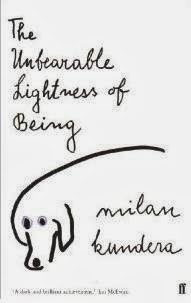
Simply unbearable

I couldn't think of very much to write about this (and could not finish it, and feel qualified to write anything), so I initially turned to the internet, to find John Banville's 2004 comments on his re-read of the novel in the Guardian, where he notes that he could not remember very much from his first reading:

Why had so little remained for me? Is it the result of failing memory, or is there indeed an essential weightlessness to the book? The Unbearable Lightness of Being had a remarkable success when it was published in English in 1984 (this autumn will see an anniversary edition from Faber). Here was an avowedly "postmodern" novel in which the author withheld so many of the things we expect from a work of fiction, such as rounded characters - "It would be senseless for the author to try to convince the reader that his characters once actually lived" - a tangible milieu, a well-paced plot, and in which there are extended passages of straightforward philosophical and political speculation, yet it became a worldwide bestseller, loved by the critics and the public alike… What is remarkable, however, is that a work so firmly rooted in its time has not dated. The world, and particularly that part of the world we used to call, with fine carelessness, eastern Europe, has changed profoundly since 1984, but Kundera's novel seems as relevant now as it did when it was first published. Relevance, however, is nothing compared with that sense of felt life which the truly great novelists communicate. And lightness, in art, more often seems like slightness. 

This was an interesting reflection, because my initial response to the novel had been to assume that I found it nearly unreadable because it had dated so badly; that its suggestion that its characters are mere literary sketches had been avant-garde and postmodern at the time, for example, but now appears trite and cliched. Reviewing the novel in 1984, the date of its publication, in The London Review of Books, John Bayley praised it to the skies but suggested, still, that, 'Whether it will last, whether one will want to read it again, are more difficult questions to answer.' Andrew Williams named it a 'Book of a Lifetime' in the Independent in 2009, and so I turned to his article to try and understand what others had seen in the book. In accordance with my first theory, he ties the experience of reading the novel in 1984 to his love for it, remembering his passion for Kundera's novels as a university student. However, unlike Banville, he seems to suggest that it does hold up on a re-reading, although it's unclear whether or not he actually re-read it to write the article. He praises the novel for 'the skill with which Kundera opens up that gap between perception and reality' in his depiction of the mutual incomprehension between Tereza and Tomas, and concludes by saying, 'This is a shamelessly clever book – at times a little cold – but exhilaratingly subversive and funny.'

My response would be: at times? It seemed to me that Kundera was uninterested in writing a novel as we traditionally understand it at all, and that Banville has hit the nail on the head when he suggests that Kundera fails to convey the 'felt life' that is the stock-in-trade of the novelist. But, of course, 'fails' is the wrong word to use, because Kundera never attempted to create a living world in the pages of this novel. It seems to me that there's often too little said, by both professional reviewers and bloggers, about judging a novel by what you wanted it to be, rather than what it is, or what the author was trying to achieve. On that basis, it would be ridiculous to criticise Kundera for the fact that his characters seem flat and contrived, because that was exactly the point he was trying to make. However, it must be obvious from the fact that I've created this post from a patchwork of other people's reviews that I have very little else to say about this book. When one doesn't agree with a writer about what a 'novel' is and what it should aim to do, then it's clear one isn't going to get very far. It's less clear, however, how we can reach such an agreement: but I wish reviewers spoke more often about the fact that often we're using sets of standards that just don't match up.

Saturday, 26 October 2013

November schedule

Friday 1st November: The Unbearable Lightness of Being by Milan Kundera

Friday 8th November: Farthest North and Farthest South #5: The Worst Journey in the World by Apsley Cherry-Garrard

Friday 15th November: Mr B's Reading Year, One

Friday 22nd November: Laura Rereading: The Believers by Zoe Heller

Friday 29th November: The Goldfinch by Donna Tartt

Friday, 25 October 2013

The history girl

As an historian, this is an odd book to review. Although Daisy Hildyard is clear in her author's note that this is fiction, it's difficult not to read it as a mix of memoir, methodology and anecdotal history, and to engage with it as one would with an academic text, not with a novel. While this didn't affect my admiration for her remarkably clear writing, it did affect my enjoyment of the narrative, as I wanted so often to stab pencils through the narrator's grandfather's pronouncements on history, forgetting that he is a fictional character serving a fictional purpose, and not an actual historian. This fictional grandfather is both radical and old school. While his focus on single historical figures, or 'great men', is traditional, his selection of individuals such as ex-slave Olaudah Equiano is not. His assertion that the historian's job is to reduce events to a simple sequence of cause and effect is so conservative as to become radical today. He also flies against postmodernist concerns about individual bias by suggesting that by looking far enough back into the past we can remove our own perspective: 'He didn't think that first-hand experience was very helpful for an historian.' Quite often, his pronouncements are completely random: considering his own eczema and that of his granddaughter, he says 'Many of the best historians, of course, have dry skin.' The text follows the relationship between the unnamed narrator and her grandfather alongside a selection of his historical stories, focusing on figures ranging from Edward IV to Peter the Great.

It's impossible to agree with much of this methodology, but of course that isn't the point. Hildyard glosses the novel when her narrator reflects near the beginning that 'My grandfather was a historian because he loved these details, not just some details, but every detail and each for its own sake.' However, she also notes that Herodotus - 'father of history' and 'father of lies', as every undergraduate historian knows - was most inaccurate at the points in his histories where he gives the most detail. So the stage is set for a conflict between complex academic theorising and the living detail of popular history - a kind of Hector-versus-Irwin debate that goes on and on. But rather than resorting to dry arguments, Hildyard lives this conflict throughout the pages of her novel. Recalling a trip made in her childhood, the narrator tells us: 'We passed a Little Chef with a playground in which there was an orange elephant that had a slide for a trunk. Then we switched lanes and sped up past Tadcaster brewery...' The detail of this bothersome orange elephant somehow goes beyond the usual suspension of disbelief we grant to novelists, perhaps because there's no reason our narrator should have remembered it; the pair don't even stop at the Little Chef, and nothing significant happens as they pass it. But at the same time, we recognise the truth of the detail (I'm only a couple of years younger than Hildyard, so much in her account of 1990s childhood was familiar to me). In the grandfather's histories I was reminded that those who seem most enthusiastic about history, most in love with communicating it, are often not professional historians - although the grandfather is supposed to have had a career as an academic. Irwin plays with essay structure, but Hector tells stories, and the stories last longer.

Hildyard is fully aware of the problems with the grandfather's approach, and uses a conspiracy theory about the death of Herbert Kitchener to illustrate this, ending with a good note on invented narratives, that they tell us something about those who wrote them even if they don't tell us much about events themselves. But in the narrator's grandfather's obsession with the gaps in the historical record emerges a sketch of a more interesting point, echoing Robert Darnton's assertion in his wonderful history, The Great Cat Massacre: 'When we cannot get a proverb, or a joke, or a ritual, or a poem, we know we are on to something. By picking at the document where it is most opaque, we may be able to unravel a hidden system of meaning... I do not believe there is such a thing as a typical peasant or a representative bourgeois. Instead of chasing after them, I have pursued what seemed to be the richest run of documents'. In this way, we cannot write off the grandfather's approach as entirely hopeless and amateur, the work of a man who, as an ex-colleague confides near the end of the novel, 'didn't even have a PhD.' Indeed, his enthusiasm for the minutiae of history may be important as well as refreshing. With this in mind, it is ironic that engaging with Hunters in the Snow feels more intellectual than joyous. Hildyard is deliberately blurring the lines between the conventions of fiction and the conventions of history here, and while I think this is a brave and worthwhile thing to attempt, I also think that no novelist I've read has managed to pull it off yet - AS Byatt's The Children's Book included. For this reason, I hope that Hildyard's next work has a bit more story, and a bit less debate; a bit more Hector, a bit less Irwin.

[NB. This was meant to be a Farthest North and Farthest South post, but I thought the scattered references in this novel to ice archives and icebergs weren't really enough to justify this. I'll make up for it next month with a post on a classic Antarctic travelogue.]